
Stalin’s Doctors’ Plot
The Anatomy of an Antizionist Libel

Stalin’s Doctors’ Plot: The Anatomy of an Antizionist Libel
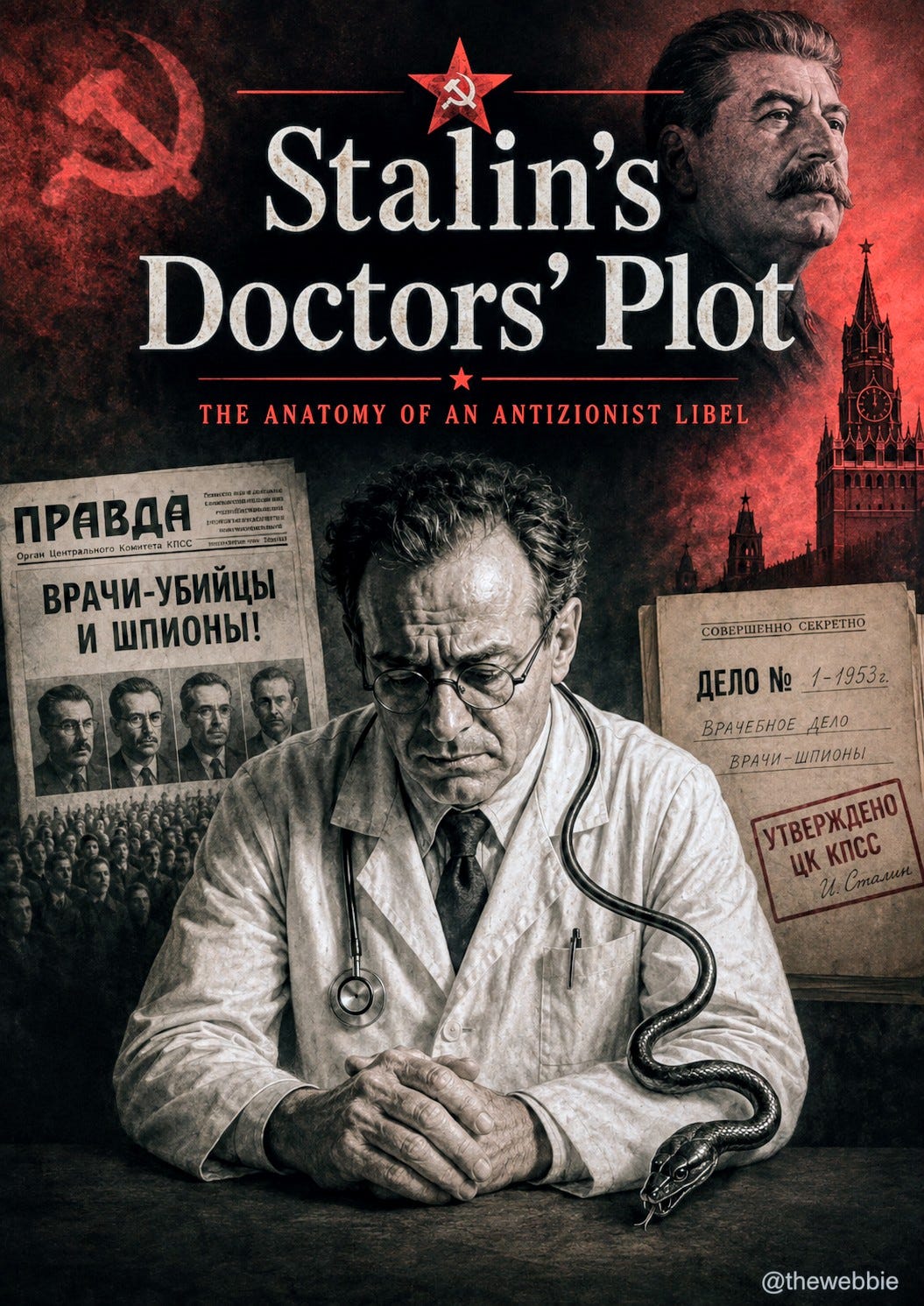
In January 1953, Stalin’s Soviet Union announced that it had uncovered a conspiracy inside one of the places people are most vulnerable: the doctor’s office.
Prominent Soviet physicians had supposedly used their access to the country’s leadership not to heal, but to murder. They were accused of deliberately misdiagnosing senior officials, prescribing harmful treatments, and participating in a larger conspiracy directed by foreign intelligence. Many of the accused doctors were Jewish, and the Soviet propaganda machine did not leave that fact sitting quietly in the background. It pulled the accusation outward, connecting the doctors to Jewish organizations, American intelligence, and international Zionism.
The episode became known as the Doctors’ Plot, one of the final great antisemitic campaigns of Stalin’s rule. But looking at it simply as another example of Stalin’s antisemitism misses something important.
The Doctors’ Plot is almost a laboratory demonstration of how a libel works.
A libel is not merely a lie. The best libels are built from pieces of reality. Something actually happened. Someone really died. A document exists. A doctor really treated the patient. The propagandist takes those fragments, assigns them a meaning they cannot support, recruits powerful authorities to validate that meaning, and then adds enough emotional horror to make the target morally repulsive.
That structure can be understood through the classical rhetorical triangle: Logos, Ethos, and Pathos.
Logos supplies the fragment of truth.
Ethos supplies the validator.
Pathos supplies the moral ugliness.
Put all three together and you have something far more dangerous than a false statement.
You have a permission structure.
- Logos: The Truth Fragment -
The Doctors’ Plot did not begin with a fictional death.
Andrei Zhdanov really died.
Zhdanov was one of the most powerful figures in the Soviet leadership and a close associate of Stalin. He died on August 31, 1948, after serious heart problems. There had also been a genuine medical dispute surrounding his condition. Dr. Lidiia Timashuk warned that Zhdanov’s doctors were underestimating the seriousness of his illness and that their treatment could have grave consequences. Her letter was real. The disagreement was real. Zhdanov’s death was real.
None of those facts established murder.
Stalin supplied that part.
Over the following years, the security apparatus transformed a medical controversy into a conspiracy. The accusation expanded from medical wrongdoing to intentional killing, from individual doctors to a network, and eventually toward Jewish nationalism, American intelligence, and Zionism.
The specifically Jewish character of the supposed conspiracy was constructed over time rather than present at the beginning. None of the physicians originally accused by Timashuk was Jewish. Soviet investigators later worked to establish a Jewish conspiracy and extracted confessions connecting it to foreign powers.
That is the first lesson.
The propagandist does not always need to manufacture the brick. He only needs to manufacture the mortar.
There really was a corpse. There really were doctors. There really was a dispute over treatment. What was false was the story connecting those facts and explaining what they supposedly meant.
This is also why the Doctors’ Plot belongs in the same historical family as the older European blood libels. Those accusations often began with something equally real and terrible: a Christian child disappeared or was found dead. There was genuine grief, genuine fear, and a genuine Jewish community nearby. The libel was the connection imposed between them. Jews supposedly kidnapped the child, murdered him, and used his blood for ritual purposes.
The body was real.
The accusation was invented.
Centuries later, Stalin changed the scenery. The dead Christian child became a dead Soviet official. Ritual murder became medical murder. The supposed Jewish religious conspiracy became a Zionist political conspiracy.
The costume had changed.
The structure had not.
- Ethos: Who Says It Is True? -
Facts and insinuations still need someone to certify the interpretation.
The medieval blood libel became exponentially more dangerous when a priest, magistrate, court, or ruler validated the accusation. Rumor acquired authority. What someone whispered became what everyone was expected to know.
Stalin had something rather more powerful than a medieval magistrate.
He had the Soviet state.
The security services investigated. TASS announced. Pravda published. Communist Party officials repeated. The government claimed evidence, confessions, witnesses, and investigative findings.
A Soviet citizen was no longer hearing that some Jewish doctors might have murdered government officials. He was being told that the state had uncovered the conspiracy.
And once the state says the murder conspiracy is real, the public is invited to skip the tedious part where somebody actually proves it.
The question changes from “Is this true?” to “How could they do this?”
Authority has laundered accusation into knowledge.
The fraud became obvious almost immediately after Stalin died. On April 4, 1953, Soviet authorities announced that the doctors had been accused “without any legal basis whatever,” released and vindicated them, and acknowledged that confessions had been obtained through prohibited interrogation methods.
The great conspiracy had not collapsed because someone discovered a new medical chart.
The validator disappeared.
So did the certainty.
- Pathos: Make the Target Disgusting -
Logos makes the accusation plausible. Ethos makes it respectable.
Pathos makes people want to act on it.
Doctors occupy a relationship of extraordinary trust. We swallow the medicines they prescribe. We place ourselves unconscious on operating tables because we assume the person standing over us is trying to keep us alive.
The Doctors’ Plot inverted that trust completely.
The healer became the murderer. The diagnosis became the weapon. The white coat became camouflage.
Then the regime performed the same trick on Jewish charity.
The American Jewish Joint Distribution Committee was a humanitarian organization with a long record of relief work. Soviet propaganda instead presented it as part of the conspiracy, an espionage organization hiding hostile activity behind humanitarian work.
Apparently charity was suspicious precisely because it looked charitable.
That inversion is the heart of the Pathos layer.
Do not trust the doctor because healing conceals murder.
Do not trust the charity because kindness conceals espionage.
Do not trust the Jew because his public face conceals a secret loyalty.
Do not trust the Zionist because what you can see is merely camouflage for what you cannot.
The accusation has now moved beyond particular people committing particular crimes. It has become an accusation of hidden moral corruption.
That was the psychological power of the older blood libel as well. The medieval Jew was not merely accused of killing. Ordinary Jewish religious and communal life became sinister because the audience had been taught that normality itself was part of the disguise.
Stalin modernized the accusation.
The blood libel had put on a white coat.
- When the Jew Became the Zionist -
The Soviet Union officially opposed racism and fascism. Naked racial antisemitism was therefore ideologically inconvenient.
So the language adapted.
Jewish nationalist.
Rootless cosmopolitan.
Agent of imperialism.
International Zionist.
The terminology sounded political and modern. The accusations underneath it were ancient.
Secret international loyalties. Foreign control. Hidden networks. Manipulation of governments. Jews infiltrating trusted institutions. Jewish organizations supposedly pursuing humanitarian goals while secretly serving a sinister political project.
This was not antisemitism disappearing.
It was antisemitism learning political vocabulary.
And that vocabulary offered an enormously useful trick: the Soviet state could condemn “Zionists” while insisting that it opposed antisemitism.
The accusation no longer needed to begin with “the Jews.”
It could arrive at much the same destination by another route.
Modern antizionist libel operates comfortably in that inherited vocabulary. It speaks about human rights, international law, colonialism, racism, oppression, and resistance. Those subjects are not themselves antisemitic. They are legitimate subjects of political argument, and Israel should not be exempt from them.
Israel is a state. States should be scrutinized. Israeli military conduct can be investigated. Civilian deaths can be examined. Government statements, aid policy, settlement policy, rules of engagement, and individual allegations of wrongdoing can all be criticized without antisemitism entering the picture at all.
The line is not crossed because someone says something harsh about Israel.
It is crossed when evidence stops being used to evaluate conduct and starts being assembled into a self-sealing theory of collective moral evil.
That is the difference between scrutiny and libel.
- The Modern Machine -
Consider the genocide accusation against Israel in Gaza.
The Logos layer contains enormous amounts of real suffering. Palestinian civilians have died. Families have been displaced. Homes and neighborhoods have been destroyed. Israeli officials have made statements that deserve scrutiny. Military decisions can and should be examined critically.
Those facts do not have to be denied to reject a libel.
They are precisely what gives the accusation something to grab.
Those are the bricks.
Now watch the mortar.
In January 2024, the International Court of Justice issued provisional measures in the case brought by South Africa under the Genocide Convention. The Court found that some of the rights South Africa sought to protect were plausible, including the right of Palestinians in Gaza to be protected from acts of genocide and South Africa’s right to seek Israel’s compliance with the Convention.
It was an interim ruling intended to preserve rights while the case proceeded. It was not a judgment that Israel had committed genocide.
Yet an enormously consequential shorthand quickly entered public discourse: the ICJ had supposedly found a “plausible genocide” in Gaza.
That is not what the Court said.
Joan Donoghue, who was president of the ICJ when the order was issued, later corrected that interpretation publicly. She explained that the Court had not decided that the genocide allegation itself was plausible.
Look at the structure.
The suffering is real.
That is Logos.
The authority of the world’s highest international court is invoked, often with the ruling subtly transformed into something stronger than it said.
That is Ethos.
Then comes “genocide,” one of the most morally radioactive accusations available in modern political language, attached to the Jewish state and repeated until disagreement itself can begin to look like complicity in mass murder.
That is Pathos.
None of this means allegations involving military conduct should not be investigated. They should be. Nor does an interim ruling tell us what a court may eventually conclude on the merits.
The problem is the leap from evidence to essence.
Israel no longer merely stands accused of particular actions.
Israel becomes genocidal.
Its claims of self-defense become excuses. Its account of October 7 becomes propaganda. Jewish historical memory becomes manipulation. Humanitarian measures become public relations. Evidence offered in Israel’s defense becomes further evidence of how sophisticated the deception supposedly is.
The accusation now protects itself from contradiction.
If Israel does something terrible, it proves the theory.
If Israel presents evidence in its defense, that proves the cover-up.
If Israel provides humanitarian aid, that proves it understands the need for appearances.
If Jews object to the accusation, that proves how coordinated Zionists are in suppressing criticism.
Heads I win. Tails, your denial proves I was right.
That is not investigation.
That is a closed belief system.
- What the Libel Is Actually For -
The blood libel was never merely about convincing people that Jews had killed a particular child.
It was about telling people what kind of creatures Jews were.
The Doctors’ Plot was not merely about convincing Soviet citizens that several doctors had committed murder. It transformed Jewish physicians, Jewish organizations, and Zionism into evidence of an invisible network hiding behind respectable institutions.
That is why the attack on charity matters so much. The audience was being taught not merely that Jews could do evil, which is obviously true of any group of human beings, but that Jewish goodness itself could not be trusted.
That is the leap from accusation to moral ugliness.
And moral ugliness creates permission.
If Jews murder Christian children, attacking the Jewish quarter can feel like justice.
If Jewish Zionist doctors are secretly murdering Soviet leaders for foreign intelligence, persecuting Jewish institutions can feel like national defense.
If Israel is transformed from a country capable of both right and wrong into a uniquely genocidal, colonial, racist enterprise whose very existence is morally criminal, hostility toward it takes on a different character.
It becomes righteous.
And then the circle widens.
The Israeli becomes the Zionist. The Zionist becomes the Jew who refuses to denounce Zionism. Jewish organizations become “Zionist organizations.” Synagogues become appropriate protest sites. Jewish schools become ideological institutions. Jewish charities become political fronts. Cultural events become legitimate targets because Zionism has already supplied the indictment.
The libel has completed its work.
It has moved from an allegation about an event to a judgment about a people.
That is why Logos, Ethos, and Pathos matter.
Logos gives the libel something real to grab.
Ethos tells the audience that the interpretation has been certified.
Pathos tells the audience what kind of monster stands before them.
When all three converge, the product is not merely misinformation.
It is permission.
The answer is not to deny every uncomfortable fact. Doing that only makes the propagandist’s job easier. The answer is to take the machinery apart.
What is the real fragment?
What meaning has been attached to it?
What context vanished?
Who validated that interpretation?
Did the validator actually say what people claim it said?
And what are you being trained to feel about the people being accused?
Those questions work whether the accusation arrives from a medieval pulpit, Stalin’s Pravda, an international institution, an NGO report, a university department, or a viral post.
The technology changes. The vocabulary changes.
The machine survives.
A real fragment. A powerful validator. Manufactured moral ugliness.
That is how a lie becomes a libel.
And that is how hatred learns to call itself moral clarity.
Around 20 years ago I was walking through the sholom home with my father-in-law and his mother who was 96 named Sonia both of them came from Moldavia, a TV was on in the hallway discussing in Russian the doctors trials, she was suddenly quieter and said sha Eduard they are listening 👀