

The Folding Table
Jewish Unity Isn’t Found in Slogans. It’s Found in the Messy Act of Showing Up.
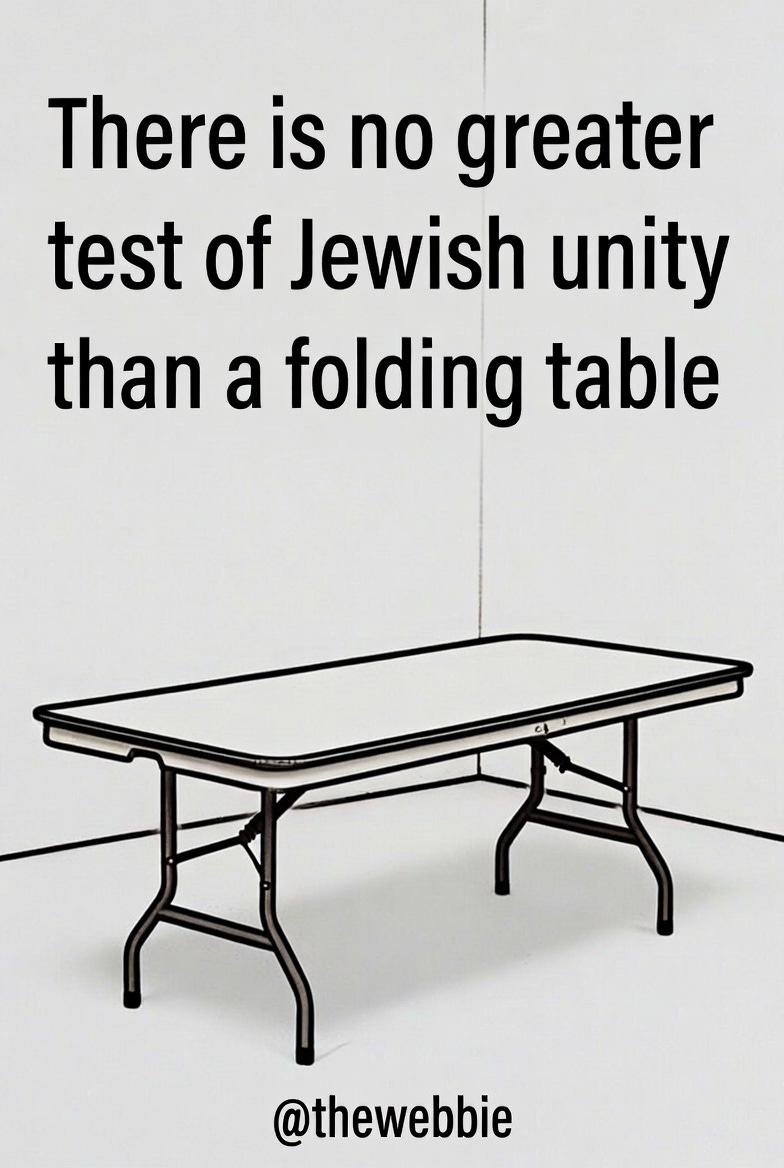
There is no greater test of Jewish unity than a folding table.
Not theology. Not politics. Not whether you say “Shabbos” or “Shabbat.” Not whether your kiddush wine tastes like Napa Valley or cough syrup with a yarmulke.
A folding table.
Because the moment a synagogue event needs setting up, every Jew suddenly becomes an engineer, a foreman, and a constitutional scholar.
“You’re opening it wrong.”
“No, the legs lock this way.”
“My uncle had one like this in 1987.”
Meanwhile, the table is upside down, someone is holding a tray of rugelach, and a child has already crawled under it like it’s the Warsaw sewer system.
This is where Jewish civilization actually lives. Not in slogans. Not in protest chants. Not in Instagram graphics with Hebrew written backwards, oy gevalt. It lives in the messy, annoying, beautiful act of showing up together and trying to build something that does not collapse before lunch.
Recently, I’ve been hard on the modern misuse of Tikkun Olam.
Not the real concept.
The bumper sticker version.
The version that takes a deep Jewish idea, strips it of Torah, peoplehood, Israel, obligation, memory, and responsibility, then repackages it as “whatever my politics already were, but now with challah.”
That is not Judaism.
That is ideology wearing a tallit as a cape.
But here is the thing.
Some people drawn to Tikkun Olam are not enemies. Many are Jews with huge hearts, decent instincts, and terrible teachers.
They were told that to be moral, they had to be universal first and Jewish second. They were told that caring about the world meant being embarrassed by their own people. They were told that Israel is the exception to Jewish compassion rather than one of its central expressions.
That lie has done enormous damage.
But damaged does not mean unreachable.
So maybe the question is not, “How do we defeat Tikkun Olam activists?”
Maybe the better question is, “How do we bring the honest ones home?”
Not by watering down truth. Not by pretending antizionism is just a spicy foreign policy opinion. It is not. When someone says the Jewish people alone do not deserve self-determination in our ancestral homeland, that is not justice. That is old hate with a graduate degree.
But we also do not build unity by turning every confused Jew into an enemy combatant.
Kol Yisrael arevim zeh bazeh.
All of Israel is responsible for one another.
That does not mean all of Israel agrees with one another. Have you met us? We can turn ordering bagels into the Council of Nicaea.
It means we are bound together anyway.
The Tikkun Olam Jew and the Zionist Jew need to meet at the folding table.
One says, “We need to repair the world.”
The other says, “Wonderful. Let’s start by not helping the world break Jews.”
At some point, compassion that skips your own family is not compassion.
It is performance.
Jewish safety is not selfish. A strong Jewish community is not a distraction from repairing the world. It is the first repair. You cannot pour from an empty kiddush cup while your own children are afraid to wear a Magen David on campus.
If a synagogue needs security guards, if Jewish students need escorts across campus, if a teenager has to tuck his Star of David inside his shirt because the “justice” crowd is marching by, then Tikkun Olam does not begin across the ocean.
It begins at the front door.
Israel is not optional wallpaper in Jewish life.
We pray toward Jerusalem. We break a glass for Jerusalem. We say “Next year in Jerusalem.” We are not a people of Instagram spirituality and Costco kugel. We are Bnei Israel. The children of Israel.
You can criticize an Israeli government. Jews have been arguing with Jewish leaders since Moses came down the mountain and found everyone acting like Burning Man had a livestock division.
But criticism of policy is not the same as denying Jewish peoplehood.
And compassion must include Jews.
If your justice movement has room for every pain except Jewish pain, it is not justice. It is selective empathy. And selective empathy is just prejudice with better lighting.
This is especially true when activists claim to stand for every marginalized group, then go silent when Jews are attacked. Or worse, when they wave “Queers for Palestine” signs while ignoring what Hamas would do to actual queer people in Gaza.
Now comes the harder part for our side.
We have to leave a door open.
Not for the professional antizionist grifters. Not for the token Jews who make careers out of laundering Jew-hate for applause. Not for the groups that show up only when Jews need to be scolded in public.
I mean the ordinary Jew who got swept up.
The college kid who wanted to be good.
The suburban activist who thought “ceasefire” meant peace and not “let Hamas reload.”
The liberal Jew who still loves their grandparents, still cries at Yizkor, still lights Chanukah candles, but got trained to think Jewish strength is morally suspicious.
We do not have to flatter their confusion.
But we can invite their return.
Sit with an Israeli family at Shabbat dinner and listen before explaining the Middle East from a TikTok carousel.
Visit a hospital where Jewish and Arab doctors treat Jewish and Arab patients while Western academics call it apartheid from buildings named after donors.
Talk to a parent whose child is still held hostage in Gaza, then try saying “resistance” with a straight face.
Stand outside a synagogue on a Friday night, not with a sign, but with your body, so Jewish families can walk in without fear.
Study Tikkun Olam from Jewish sources before using it as a slogan against Jews.
Learn what Zionism actually means before declaring it evil.
Come to Israel.
Not the fantasy Israel from a protest flyer.
The real one.
Loud, wounded, brilliant, stubborn, holy, infuriating, alive.
That is an invitation.
But the table has terms.
No erasing Jewish history.
No excusing Hamas.
No pretending Jewish fear is manipulation.
No using “as a Jew” as a permission slip to harm other Jews.
No repairing the world by dismantling the Jewish soul.
That is not unity through silence.
That is unity through standards.
And yes, we on the unapologetically Zionist side have work to do too.
Sometimes we confuse vigilance with contempt.
Sometimes we are so used to being betrayed that we stop distinguishing between the malicious and the misled.
Sometimes our anger is righteous, but our delivery turns into a flamethrower at a family barbecue.
I say this as someone who has occasionally brought the flamethrower and extra propane.
But if we want Jews to come back, we need to leave room for return.
Teshuvah means return.
It does not mean pretending the mistake never happened. It means the door is open when the person is ready to stop walking away.
That is how family works.
Not always softly.
But seriously.
Tikkun Olam begins with Tikkun Atzmi, repairing ourselves.
Then Tikkun Kehillah, repairing the community.
Then, yes, we turn outward.
That order matters.
A Jew who loves humanity but despises Jewish survival has not transcended tribalism. He has simply joined someone else’s tribe.
A Jew who fights for the vulnerable but cannot defend Jewish children from hate has not expanded compassion. He has misplaced it.
A Jew who wants peace but cannot say Hamas is evil is not a peacemaker. He is a hostage negotiator for his own conscience.
Still, I believe we can work together.
Not everyone.
Not yet.
Maybe not soon.
But some.
The ones willing to trade slogans for study.
The ones willing to replace performance with responsibility.
The ones willing to say, “I still care about the world, but I will no longer do it by abandoning my people.”
That is the bridge.
Not left to right.
Not religious to secular.
Not Israel first versus humanity first.
Jewish truth first.
From there, we can feed the hungry, comfort the grieving, defend the vulnerable, protect our children, argue like lunatics, laugh like cousins, and maybe even set up the folding table without anyone losing a finger.
Okay, fine.
Someone will still lose a finger.
We are Jews. Miracles have limits.
But the table matters.
Because every generation of Jews has inherited some version of it.
A little bent.
A little scratched.
Harder to open than it should be.
Covered in crumbs from people who swear they did not eat over it.
And still, we unfold it.
We lock the legs.
We argue over where it belongs.
We cover it.
We bless over it.
We feed people from it.
We teach children around it.
We welcome the lost back to it.
And when the world tries, again, to scatter us into frightened little pieces, we do what Jews have always done.
We pull up another chair.
The table stands.
So do we.


